Motivation in the Courtroom: How Jurors Decide & How You Stay Grounded
Motivation is one of those words we throw around a lot — but rarely do we slow down and ask how it actually works.
Today, I want to look at motivation from two perspectives:
-
What motivates jurors to engage, process information, and ultimately reach a verdict?
-
How do you stay motivated — especially when the work feels heavy or overwhelming?
These two perspectives might seem disconnected, but they're interrelated because, jurors don’t get motivated in a vacuum. They’re responding to you — your energy, your steadiness, and how grounded you are in your own process.
What Jurors Are Carrying Before You Ever Speak
Before opening statements begin — before a single piece of evidence is presented — jurors are already managing a lot.
They’ve been compelled to attend jury selection.
They’re unsure how long service will last.
They’re worried about work, family obligations, and disruption.
They’re in unfamiliar spaces, and have to abide by unfamiliar rules.
Most jurors enter the courtroom feeling:
-
uncertain
-
slightly uncomfortable
-
out of place
-
unsure what they’re supposed to contribute
And beneath all of that? A low-grade sense of inadequacy.
Then you begin talking about premises liability, federal motor carrier safety regulations, or hypoxic ischemic encephalopathy — language they’ve never used, never needed, and never discussed over coffee with friends.
This isn’t about jurors being unwilling or incapable. It’s about their brains having no entry point.
Why Facts Alone Don’t Motivate Jurors
Jurors don’t disengage because they don’t care. They disengage because the information doesn’t yet relate.
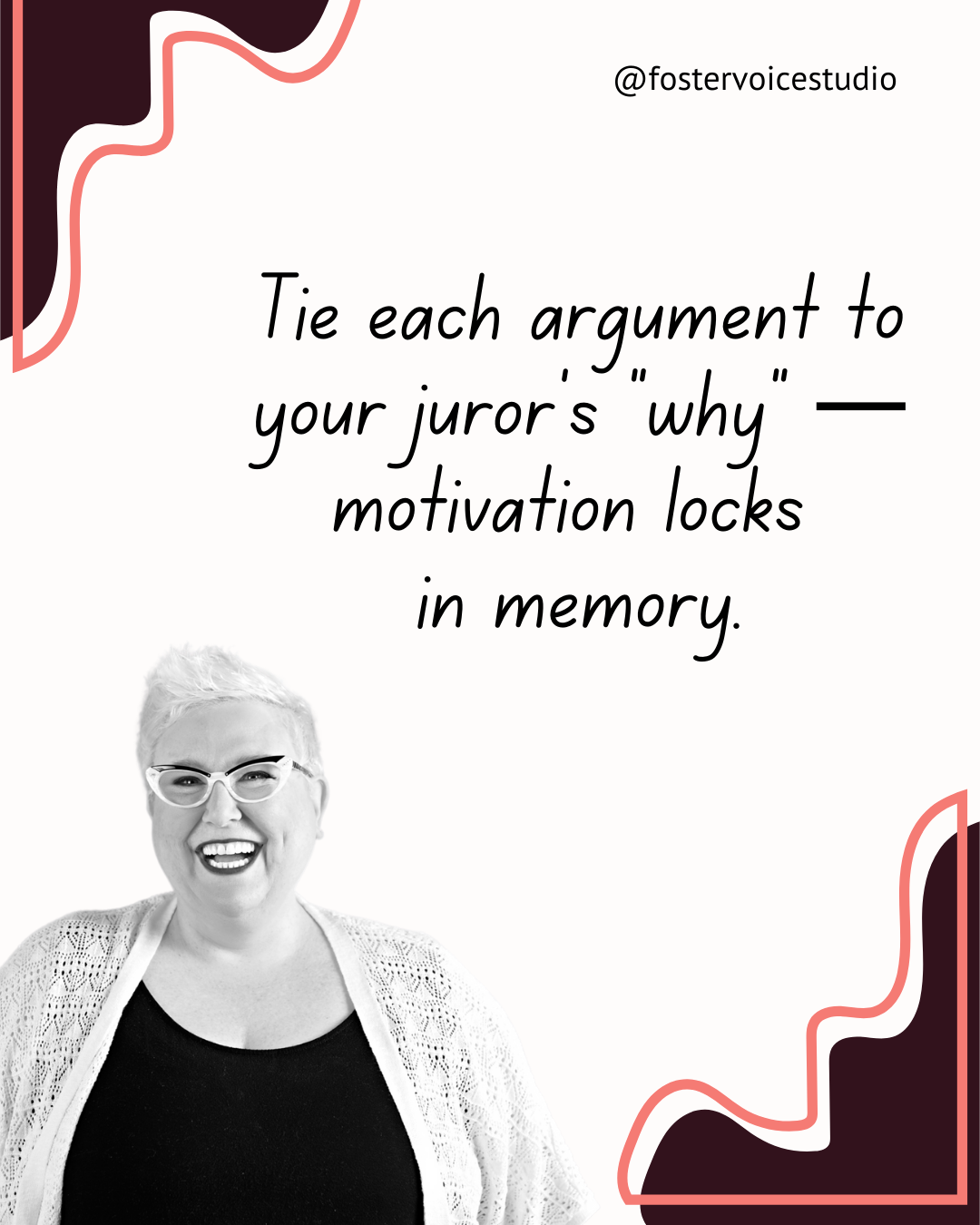
Facts don’t land unless they’re attached to meaning. So the goal isn’t to abandon the facts — the facts matter deeply — but to anchor those facts in shared values and lived experience.
If your case involves a construction-site death, most jurors won’t have worked on a job site. But every juror understands:
-
expectations of safety in shared spaces
-
trust in systems designed to protect people
-
the fear of preventable harm
-
responsibility within a functioning community
When the case expands beyond a specific site and into universal principles — safety, responsibility, trust — jurors finally have a place to stand. That’s when motivation begins.
Motivation Starts with Relevance, Not Information
Jurors engage when they can answer:
-
Why does this matter?
-
How does this affect people like me?
-
What’s at stake for the community?
This isn’t selfishness. It’s neuroscience. The human brain prioritizes what feels personally relevant. Once jurors feel emotionally and morally invested, they don’t just remember your case — they advocate for it during deliberations.
Information follows relevance. Not the other way around.
Now the Harder Question: How Do You Stay Motivated?
Before jurors ever get motivated, you do. And this is where many attorneys struggle.
We tend to think of motivation as a feeling — something that appears when conditions are perfect:
-
clarity
-
confidence
-
energy
-
inspiration
But motivation doesn’t work that way. Motivation is not something you wait for. It’s something you practice.
The Soundtracks That Sustain Motivation
Over the last year, I’ve paid close attention to what helps me stay in motion — not perfectly, but consistently. One of the most powerful tools I use comes from Jon Acuff: soundtracks.
Soundtracks are short, repeatable internal phrases — not hype quotes, not platitudes — but anchors.
Here are a few that consistently help me, especially when motivation dips.
Soundtrack #1: Action Breeds Creativity
When motivation is low, the brain says:
-
“I need more clarity before i can begin.”
-
“I’ll start once I feel ready.”
-
“I don’t know how to do this yet.”
But clarity doesn’t come before action. It comes from action.
One small step creates information.
Information creates options.
Options create momentum.
Momentum — not perfection — is what sustains progress.
Soundtrack #2: Some Is Better Than None
All-or-nothing thinking kills motivation fast.
Some preparation is better than none.
Some vocal warm-up is better than none.
Some intention is better than none.
Motivation grows in reps, not leaps. Tiny reps still count.
Soundtrack #3: Growth Is the Goal — Not Comfort
Comfort feels good, but it doesn’t change anything.
Growth feels awkward.
Unpolished.
Sometimes embarrassing.
That discomfort isn’t a warning sign — it’s a confirmation that you’re expanding on purpose.
Soundtrack #4: You Don’t Feel Motivated — You Practice Motivation
Motivation isn’t a personality trait. It’s not something you either have or don’t. It’s a practice.
You practice motivation by:
-
choosing the next doable step
-
keeping small promises to yourself
-
showing up imperfectly and staying engaged
And when you practice motivation internally, you model steadiness and regulation externally.
Final Thought: Motivation Is Built, Not Found
As you think about motivating jurors, ask yourself:
-
What soundtrack am I rehearsing when things feel hard?
-
Is it moving me forward — or keeping me stuck?
Because the same nervous system you’re trying to regulate for jurors…is the one you’re living in every day.
Choose soundtracks that:
-
create movement
-
build momentum
-
keep you in the process
That’s how motivation is built — not discovered.
Until next time…keep fostering your voice.
LET'S STAY CONNECTED
You’re already speaking. Let’s make it count.
Get one smart, time-saving vocal tip each Tuesday to help jurors learn faster, retain more, and stay connected — so your message lands the first time.
You're safe with me. I'll never spam you or sell your contact info.